Mushroom Growing Containers: Cost and Container Farm Design
What Mushroom Growing Containers Are and Why They Differ from Plant Farms
A mushroom growing container is a compact controlled environment designed specifically for fungal production rather than leafy crops. While container-based farming is often associated with hydroponic greens, mushroom cultivation introduces a very different set of engineering requirements. Instead of maximizing light efficiency and nutrient delivery, mushroom systems focus on humidity control, air exchange, and contamination management.
This difference fundamentally changes how the container must be designed. Mushrooms do not require intense lighting, but they demand extremely stable humidity and carefully controlled CO₂ levels. High moisture combined with organic substrate creates a sensitive environment where small imbalances can quickly lead to contamination or uneven fruiting. Because of this, mushroom containers behave more like controlled climate chambers than traditional vertical farms.
The compact nature of a shipping container mushroom farm amplifies these effects. Limited volume means that humidity rises quickly, CO₂ accumulates faster, and airflow must be carefully managed to avoid condensation. This makes engineering decisions more critical than in larger indoor facilities where environmental buffers exist.
Container-Based Mushroom Production Concept
Mushroom container farming typically relies on shelving systems loaded with substrate blocks or grow bags. These are arranged vertically to maximize production per footprint. Unlike hydroponic systems, the production cycle is driven by biological stages: incubation, colonization, and fruiting. Each stage has different environmental requirements.
Incubation usually requires higher temperatures and lower airflow, while fruiting requires cooler conditions with significantly increased fresh air exchange. In a container environment, these transitions must be managed carefully. Sudden changes in airflow or humidity can disrupt development and reduce yield consistency.
Because of this, many mushroom growing container designs either separate incubation and fruiting into different spaces or operate the container only as a fruiting chamber while incubation is handled externally. This decision affects both cost and operational complexity.
Why Mushrooms Require More Aggressive Climate Control
Mushrooms release moisture continuously during fruiting. Relative humidity typically needs to remain between 85 and 95 percent, depending on species. At the same time, CO₂ must be removed through fresh air exchange. These two requirements create a difficult balance. Increasing ventilation removes CO₂ but also reduces humidity. Increasing humidification can create condensation on surfaces.
In larger facilities, this balance can be managed with distributed airflow and zoned control. Inside a container, however, the environment is more sensitive. Small changes in airflow can create localized dry zones or overly wet areas. This leads to uneven growth between shelves and inconsistent quality.
Condensation is one of the most common issues in mushroom containers. When warm humid air contacts cooler surfaces, water forms on walls and ceilings. This increases contamination risk and creates sanitation challenges. As a result, insulation, airflow direction, and dehumidification strategy become critical parts of the design.
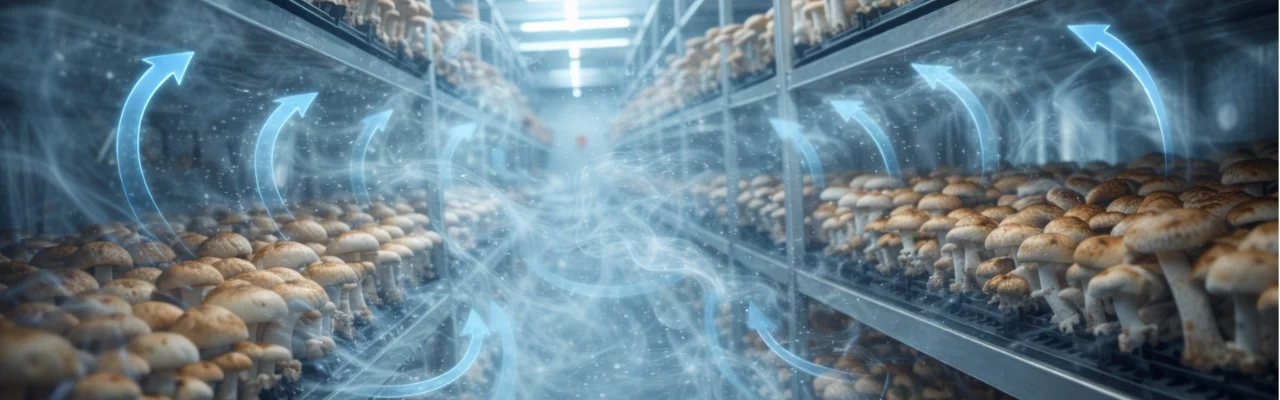
Mushroom Container Farm Layout and Internal Zoning
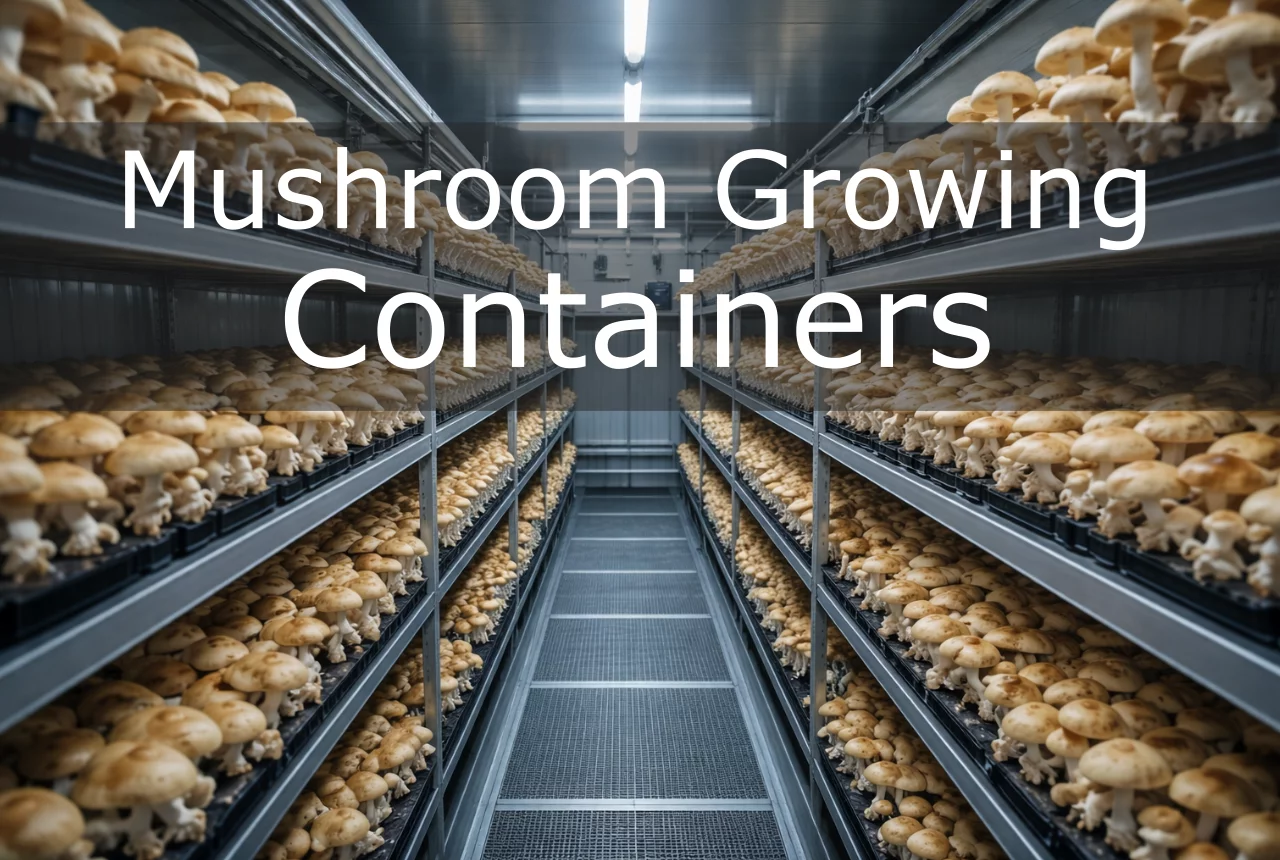
The internal layout of a mushroom container directly affects productivity and stability. Most systems rely on multi-level shelving along both sides of the container, with a central aisle for access. This configuration maximizes growing area but restricts airflow paths.
Air is typically supplied from one end or from overhead ducts and recirculated across shelves. If airflow is not evenly distributed, upper shelves may receive different humidity and CO₂ levels than lower shelves. This creates inconsistent fruiting patterns and complicates harvesting.
The narrow geometry of containers also limits maintenance access. Workers must move carefully between shelves, and equipment placement must account for cleaning and sanitation. These operational factors influence both labor cost and contamination risk.
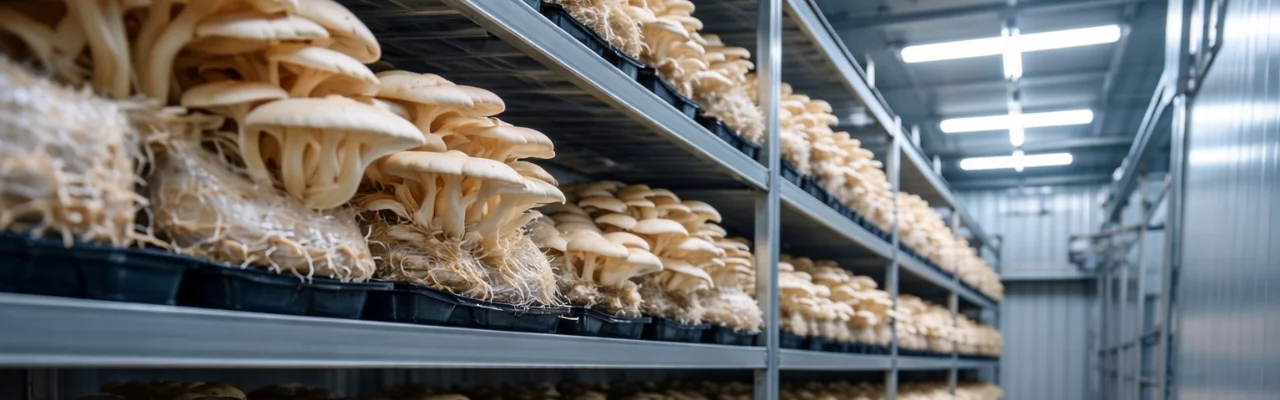
Incubation vs Fruiting Zones
Some mushroom growing containers are designed as combined incubation and fruiting systems. This approach simplifies logistics but increases climate control complexity. Incubation requires minimal airflow and stable temperature, while fruiting requires high fresh air exchange and strong humidity control.
Operating both stages in a single container requires frequent parameter adjustments. This can introduce instability, especially if the system lacks sufficient control precision. For this reason, many commercial setups use separate incubation spaces and dedicate containers only to fruiting.
This separation improves consistency but increases infrastructure requirements. Additional space is needed for incubation, and logistics become more complex. The trade-off between simplicity and control is one of the central design decisions.
Shelving Density and Airflow Constraints
Increasing shelving density improves theoretical production per container. However, higher density restricts airflow and reduces tolerance to humidity variation. This creates a system that is efficient on paper but sensitive in operation.
Air must move evenly across all shelves to maintain consistent conditions. If airflow is too strong, it can dry the substrate surface. If airflow is too weak, CO₂ accumulates and growth slows. Achieving this balance in a narrow container requires careful duct placement and fan sizing.
In practice, slightly lower density often improves overall yield by stabilizing the environment. This highlights the difference between maximum capacity and consistent production.
Humidity and Condensation Management Inside Containers
Humidity control is one of the defining features of mushroom container design. High-pressure fogging, ultrasonic humidifiers, or evaporative systems are commonly used. Each method affects airflow and condensation differently.
Uniform distribution of moisture is essential. If humidity is delivered unevenly, some shelves receive excessive moisture while others dry out. This leads to inconsistent fruiting and uneven harvest timing.
Surface condensation must also be managed. Proper insulation, controlled airflow, and staged humidification help reduce water accumulation on walls and ceilings. Without these measures, contamination risk increases significantly.
Mushroom Container Cost: Real CAPEX Ranges
The cost of a mushroom growing container varies depending on level of automation, insulation quality, and climate control design. Basic converted containers typically start around $35,000 to $60,000. More advanced systems with integrated airflow, humidity control, and automated monitoring usually fall between $60,000 and $120,000. High-spec units designed for commercial production can exceed $150,000.
These ranges reflect differences in engineering rather than just equipment quality. Containers designed primarily for demonstration or small-scale production often use simplified airflow and humidity systems. Commercial units usually include better insulation, more precise control, and improved internal layout.
When evaluating mushroom growing containers for sale, it is important to understand what is included. Some systems provide only the structural conversion and shelving, while others include full climate control, sensors, and automation. This makes direct price comparison difficult unless the specification is clearly defined.
Typical 20ft and 40ft Container Pricing
Twenty-foot containers are typically used for smaller production or pilot projects. They require lower initial investment but provide limited capacity. Costs usually range between $35,000 and $70,000 depending on configuration.
Forty-foot containers are more common for commercial mushroom production. They provide more shelving space and better airflow design opportunities. Pricing typically falls between $60,000 and $150,000 depending on equipment level.
Although larger containers cost more, they often provide better cost efficiency per unit of production. The additional volume improves airflow stability and reduces sensitivity to environmental fluctuations.
Cost per m² vs Cost per kg Production
Cost per square meter is not always meaningful for mushroom containers. Production depends more on shelf density and cycle timing than on floor area. A container with lower density but stable conditions may outperform a higher density system with inconsistent climate.
Yield varies by species and substrate. Oyster mushrooms may produce several hundred kilograms per cycle in a well-optimized container, while shiitake production is typically lower but longer in duration. These differences affect economic evaluation.
Because of this, cost per kilogram of output is often more useful than cost per square meter. Stable production cycles reduce variability and improve planning, which has a direct impact on profitability.
What Drives Cost: HVAC, Humidity, Airflow
Climate control is the primary cost driver in mushroom containers. Maintaining high humidity while removing CO₂ requires continuous airflow and humidification. This increases both equipment cost and energy demand.
Insulation also plays a critical role. Poor insulation increases temperature fluctuations and condensation. Better insulation raises initial cost but improves stability and reduces operating expense.
Air distribution systems, including ducts and circulation fans, also influence cost. Uniform airflow improves consistency but requires more careful design. Simplified airflow systems may reduce cost but increase operational risk.
Operating Costs: Energy, Labor, and Substrate Logistics
Operating costs for mushroom containers are shaped by humidity control, ventilation, and labor. Unlike hydroponic farms, lighting is not a major energy consumer. Instead, humidification and air exchange dominate energy use.
Ventilation is required to remove CO₂ generated by mushrooms. Fresh air must be introduced continuously, especially during fruiting. This increases heating or cooling demand depending on climate.
Humidity systems also consume energy and water. Fogging systems operate frequently to maintain high relative humidity. Inconsistent humidification increases both energy use and contamination risk.
Humidity and Ventilation Energy Demand
Mushroom containers require frequent air exchange. This introduces external air that must be conditioned. In cold climates, this means heating. In warm climates, cooling becomes necessary.
Maintaining humidity during ventilation is particularly challenging. Fresh air reduces humidity, requiring additional humidification. This interaction increases overall energy demand.
Efficient systems balance airflow and humidity to minimize energy use while maintaining stable conditions.
Labor and Harvest Cycles
Mushroom production involves regular loading and unloading of substrate. This creates periodic labor peaks. Harvesting is also manual in most container systems.
Cycle timing influences labor distribution. Shorter cycles require more frequent handling. Longer cycles reduce handling frequency but may reduce overall output.
Container layout also affects labor efficiency. Narrow aisles and dense shelving increase harvesting time and reduce productivity.
Substrate Handling and Turnover Cost
Substrate logistics are a major operational factor. Containers must be loaded with fresh substrate and cleared after harvest. This requires planning and handling space.
Some systems rely on pre-inoculated blocks delivered to the site. Others perform inoculation separately. Each approach affects cost and workflow.
Efficient turnover reduces downtime between cycles and improves overall productivity.
Container mushroom farms and indoor mushroom facilities solve similar problems with different approaches. Containers provide modular production units. Indoor farms use larger shared environments.
Containers offer isolation advantages. Each unit operates independently, reducing contamination spread. Indoor farms require more careful zoning to achieve similar isolation.
However, indoor farms provide greater flexibility. Layout, airflow, and capacity can be adjusted more easily. This allows optimization as production scales.
Flexibility vs Standardization
Containers are standardized systems. This simplifies deployment and operation. However, it limits adaptability.
Indoor farms allow customization. Systems can be adjusted based on experience. This improves long-term efficiency.
The choice depends on whether predictability or flexibility is more important.
Scaling Multiple Containers
Scaling with containers is straightforward. Additional units replicate the same production model. This simplifies planning.
However, each container requires separate climate control. This reduces efficiency at scale.
Indoor farms scale more efficiently by sharing infrastructure.
Contamination Risk and Isolation
Containers provide natural isolation. Contamination in one unit does not affect others. This improves resilience.
Indoor farms require zoning to achieve similar protection. This increases design complexity.
Isolation is one of the strongest advantages of container-based mushroom production.
Hidden Problems in Mushroom Containers
Mushroom containers face specific operational challenges. These issues often appear only after production begins.
Condensation is one of the most common problems. High humidity combined with temperature differences leads to water accumulation on surfaces.
This creates contamination risk and sanitation challenges.
Condensation and Contamination Risk
Water accumulation on walls and ceilings creates favorable conditions for contaminants. Regular cleaning becomes necessary.
Insulation and airflow design help reduce condensation. However, complete elimination is difficult.
Managing moisture is critical for consistent production.
CO₂ Accumulation and Airflow Limitations
Mushrooms produce CO₂ continuously. Insufficient ventilation slows growth and affects morphology.
Containers require careful airflow design to prevent buildup. Uneven airflow creates variation between shelves.
Balancing airflow and humidity remains a key challenge.
Uneven Fruiting Between Shelves
Upper and lower shelves often experience different conditions. This leads to uneven fruiting.
Adjusting airflow direction helps improve uniformity. However, perfect distribution is difficult.
Uniform conditions improve harvest consistency.
When Mushroom Containers Make Sense and When They Don’t
Mushroom containers are well suited for small-scale production, pilot projects, and distributed farming. They allow rapid deployment and modular expansion.
For large-scale industrial production, indoor farms may provide better efficiency. Shared infrastructure improves cost per unit.
The decision depends on scale, logistics, and operational goals.
Small Production and Pilot Projects
Containers allow quick startup. They reduce design complexity and enable testing.
This makes them suitable for early-stage projects.
Distributed Local Production
Containers can be deployed near markets. This reduces transport cost.
Local production improves freshness.
Industrial Scale Limitations
Scaling many containers increases complexity. Each unit requires maintenance. Large indoor farms may be more efficient at scale.