This website uses cookies to improve functionality and analyze traffic. By continuing to browse or interact with the site, you consent to our use of cookies and acknowledge that you have read and agreed to our Privacy Policy and Terms & Conditions.

Hydroponic systems are the core technology behind high-efficiency Controlled Environment Agriculture (CEA), enabling precise root-zone management, accelerated growth cycles and predictable yields year-round. NFT (Nutrient Film Technique), DWC (Deep Water Culture), RDWC (Recirculating Deep Water Culture) and Drip irrigation systems support a wide range of crops, from leafy greens and herbs to vine crops and large-fruiting varieties. These systems reduce water consumption, minimize soil-borne risks and create a fully controllable environment for commercial greenhouses, indoor farms and vertical farming facilities.
Each hydroponic method offers unique benefits depending on crop type, production scale and operational strategy.
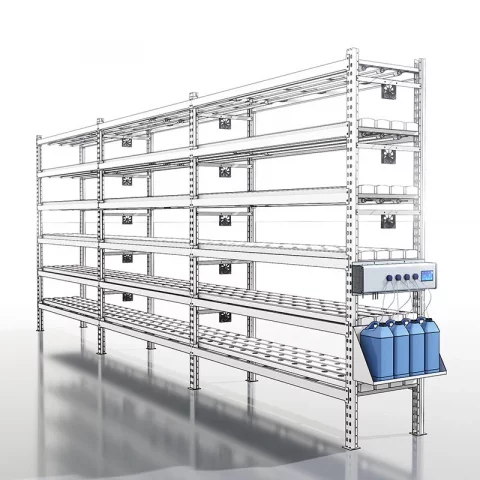
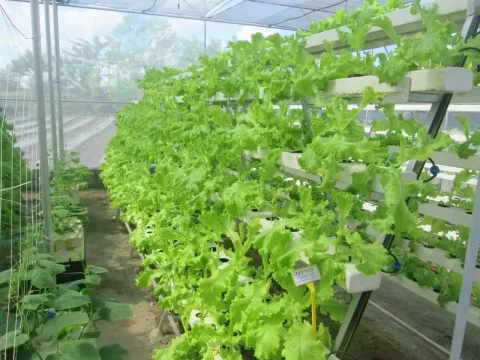
NFT (Nutrient Film Technique). A thin film of nutrient solution flows through channels, providing excellent oxygenation and rapid growth. Ideal for lettuce, herbs, leafy greens and small plants. Highly efficient for vertical farms and multilayer installations.
DWC (Deep Water Culture). Plant roots are fully submerged in oxygenated nutrient solution. DWC supports fast growth and is suitable for leafy greens and high-density production. Stable water volume reduces nutrient fluctuations.
RDWC (Recirculating Deep Water Culture). An advanced version of DWC with continuous water circulation and centralized nutrient control. RDWC is popular for high-performance production where precise EC/pH balance and strong oxygenation are critical.
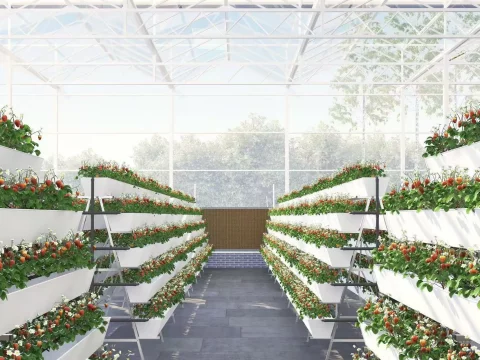
Drip hydroponics. A versatile method used for tomatoes, cucumbers, peppers, berries and vine crops. Nutrient solution is applied directly to the root zone via drippers, with runoff collected and recirculated. Ideal for greenhouses and substrate-based production.
These systems allow operators to optimize nutrient delivery, reduce labor and increase yield predictability across all CEA environments.
Hydroponic systems are used across multiple production models due to their efficiency, reliability and scalability.
Greenhouses. NFT and Drip systems dominate commercial greenhouse operations, offering excellent climate adaptability and compatibility with large-scale production lines.
Indoor and vertical farms. NFT and RDWC systems are common in vertical racks and multilayer configurations due to low water volume, efficient oxygenation and compact design.
R&D centers and nurseries. Controlled hydroponic environments enable consistent experiments, rapid propagation and uniform seedling development.
Premium crop production. Specialty greens, microgreens, herbs and niche varieties benefit from the precision and clean root-zone environment hydroponic systems provide.
High-density urban farming. Hydroponics enables high output in limited space, supporting urban agriculture, container farms and small-footprint facilities.
Across all applications, hydroponics supports year-round consistency, superior resource efficiency and reduced crop losses.
Choosing the right hydroponic system requires evaluating project goals, crop requirements, facility design and operational capacity.
Crop-specific needs. Leafy greens thrive in NFT and DWC; vine crops require Drip irrigation; RDWC suits high-performance indoor operations.
Climate and environmental conditions. Water temperature, humidity and air movement influence root-zone oxygenation, nutrient uptake and overall plant health.
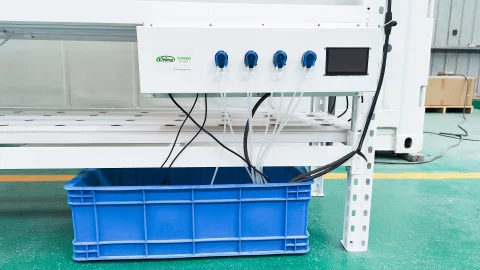
Automation and monitoring. Integration with fertigation controllers, EC/pH sensors, DO meters and automated dosing systems improves consistency and reduces labor.
Space utilization. Vertical farms and container systems benefit from compact NFT channels or modular RDWC layouts designed for tiered configurations.
Recirculation strategy. Closed-loop systems reduce water consumption and improve nutrient-use efficiency but require filtration, UV sterilization or microbial control strategies.
Maintenance and serviceability. Easy access to channels, drip lines, pumps and reservoirs helps maintain reliability in long-term operations.
Proper system design directly affects yield stability, uniformity, disease resistance and operating costs.
Hydroponic equipment varies widely by quality and engineering level. Buyers should consider:
Material quality. UV-stable plastics, food-grade reservoirs, durable channels and corrosion-resistant fittings improve system lifespan.
Pump and aeration performance. High-efficiency pumps and strong oxygenation are essential for DWC/RDWC stability.
Compatibility with automation. Systems should integrate smoothly with fertigation controllers, sensors and IoT platforms used in modern CEA farms.
Ease of scaling. Modular systems allow expansion without redesigning the entire facility.
Supplier expertise. Manufacturers with experience in CEA deliver better engineering support, documentation and technical guidance.
On CEAUnion, manufacturers, integrators and growers can list a full range of hydroponic systems—NFT channels, DWC/RDWC tanks, drip lines, pumps, fittings, reservoirs, control systems and turnkey hydroponic installations. Buyers can compare technologies, evaluate specifications and contact sellers directly to plan, scale or upgrade hydroponic operations for any type of CEA facility.