This website uses cookies to improve functionality and analyze traffic. By continuing to browse or interact with the site, you consent to our use of cookies and acknowledge that you have read and agreed to our Privacy Policy and Terms & Conditions.

Recirculating Aquaculture Systems (RAS) represent the most advanced form of controlled-environment fish production, enabling high-density, land-based farming with minimal water use and unparalleled control over biological and environmental parameters. RAS facilities rely on specialized engineering, water-treatment equipment and automated control systems to maintain optimal conditions for fish health, feed conversion, growth rates and biosecurity. Commercial RAS solutions are used for salmon, trout, tilapia, catfish, sturgeon, shrimp and other high-value aquatic species, offering predictable year-round production and scalable operational efficiency.
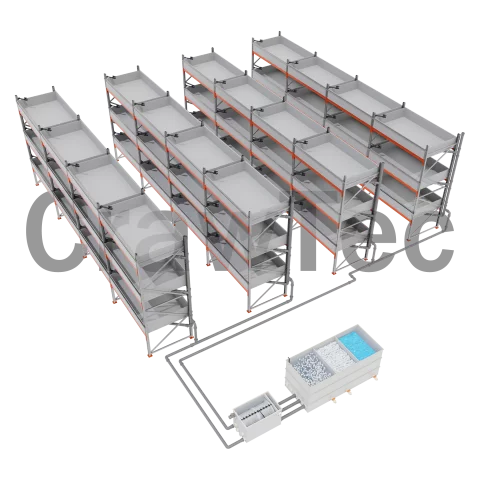
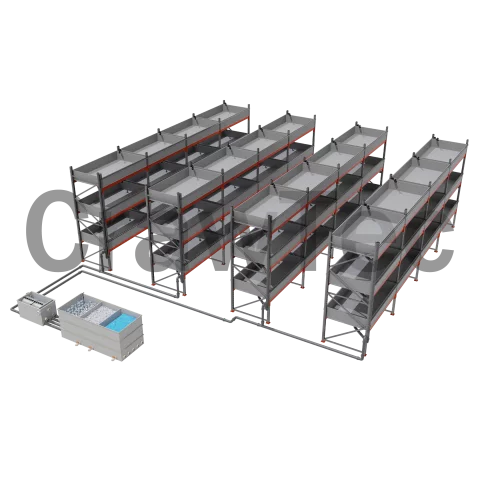
Complete RAS systems integrate a wide range of mechanical, biological and disinfection components, each performing a critical function within the recirculating loop.
Drum filters (mechanical filtration). Micro-screen drum filters remove suspended solids and waste particles, protecting pumps, biofilters and downstream equipment. They form the first essential stage in water clarification.
MBBR and biofiltration units. Moving Bed Biofilm Reactors (MBBR) convert toxic ammonia (NH₃) and nitrites into less harmful nitrates through nitrifying bacteria. Stable biofiltration ensures water quality and supports optimal feeding strategies.
Protein skimmers and foam fractionators. Skimmers remove dissolved organic compounds and help maintain water clarity, oxygen transfer efficiency and pathogen reduction.
Oxygenation and aeration systems. Oxygen cones, diffusers, low-head oxygenators (LHO) and aeration grids deliver precise oxygen levels required for high-density stocking and optimal feed conversion ratios (FCR).
UV sterilizers and ozone units. Disinfection systems reduce pathogen load, control microbial populations and improve overall biosecurity. Ozone also enhances water clarity and oxidation efficiency.
Pumps and hydraulic systems. Energy-efficient pumps maintain stable recirculation flows and pressure across the entire RAS loop. Proper hydraulic design is essential for biofilter performance and system reliability.
CO₂ degassing systems. Packed columns and degassing towers remove excess carbon dioxide produced by fish metabolism and biological filtration.
Monitoring and automation. Sensors track dissolved oxygen (DO), pH, temperature, ammonia, nitrites, nitrates, ORP and water flow. Integrated controllers and SCADA platforms automate alarms and setpoint adjustments.
Together, these components maintain stable, safe, high-performance aquatic environments for commercial-scale production.
RAS technology is used globally in commercial aquaculture, research, hatchery operations and land-based seafood production. Key advantages include:
High-density and year-round production. RAS facilities support high stocking densities with predictable growth cycles independent of season, climate or location.
Biosecurity and disease control. Fully controlled environments reduce pathogen exposure, eliminate parasite risks (e.g., sea lice) and improve survival rates.
Low water consumption. RAS systems recycle up to 99% of water, making them suitable for regions with water scarcity or strict environmental regulations.
Feed efficiency and growth optimization. Stable oxygen, temperature and water quality conditions enable improved FCR and predictable biomass gain.
Geographic flexibility. RAS allows seafood production close to major markets, reducing transport cost and carbon footprint while improving product freshness.
Environmental sustainability. Controlled discharge, solids capture, and low nutrient waste footprints help meet modern sustainability requirements.
Support for high-value species. Sturgeon, salmon, barramundi, trout, shrimp and other premium species benefit significantly from controlled-environment production.
These advantages make RAS one of the fastest-growing sectors in global aquaculture, supported by strong investment and demand for sustainable seafood.
Choosing complete RAS systems and equipment packages requires detailed evaluation of engineering, biological and operational parameters.
Species-specific requirements. Each species demands unique water quality, oxygenation, temperature and hydraulic conditions. System design must match biological needs.
Flow rates and system turnover. Proper recirculation rates ensure sufficient filtration contact time, degassing efficiency and oxygen saturation.
Energy consumption. Pumps, oxygenation, blowers and climate control systems are major energy loads. Efficient component selection improves long-term economics.
Scalability and modularity. Facilities often expand in phases. Modular RAS units enable predictable scaling without redesigning the entire system.
Automation and data logging. Real-time monitoring and automated controls improve stability and reduce labor costs, especially in high-density operations.
Biosecurity and redundancy. Backup oxygen supply, dual-pump loops, disinfection stages and emergency systems are critical for risk mitigation.
Vendor experience and engineering capability. Proven suppliers with commercial references ensure equipment reliability and proper system integration.
On CEAUnion, manufacturers, integrators and aquaculture engineering firms can list complete RAS solutions, biofilters, drum filters, oxygenation systems, UV/ozone units, pumps, tanks and turnkey farm installations. Buyers, growers and investors can compare technologies, review specifications and contact suppliers directly for commercial RAS projects.