This website uses cookies to improve functionality and analyze traffic. By continuing to browse or interact with the site, you consent to our use of cookies and acknowledge that you have read and agreed to our Privacy Policy and Terms & Conditions.

Biofilters and MBBR (Moving Bed Biofilm Reactor) systems are the biological core of modern Recirculating Aquaculture Systems (RAS) and advanced aquaponic and aquaculture facilities. These systems convert toxic nitrogen compounds—primarily ammonia (NH₃/NH₄⁺) and nitrite (NO₂⁻)—into less harmful nitrate (NO₃⁻) through nitrifying bacteria. Reliable biological filtration ensures stable water quality, strong fish health, efficient feeding performance and long-term operational stability in high-density culture environments. Properly engineered biofilters are essential for maximizing biomass, reducing mortality and maintaining optimal water chemistry.
Biofiltration is a microbiological process where beneficial bacteria colonize high-surface-area media and convert nitrogen waste through nitrification.
Ammonia oxidation. Fish excrete ammonia through gills and metabolic processes. Ammonia-oxidizing bacteria (AOB) convert NH₃/NH₄⁺ to nitrite (NO₂⁻), preventing toxic buildup.
Nitrite oxidation. Nitrite-oxidizing bacteria (NOB) convert NO₂⁻ into nitrate (NO₃⁻), which is far less harmful. Stable nitrification prevents nitrite toxicity and supports fish growth.
Biofilm formation. Specialized media (K1, K3, HDPE carriers, foams, structured blocks) provide massive protected surface area where bacteria attach and develop biofilm layers.
Mechanical–biological separation. Mechanical filtration removes solids first, ensuring clean water enters the biofilter and preventing clogging or oxygen depletion in the biological stage.
Oxygenation and mixing. Aeration, diffusers and water agitation maintain oxygen-rich conditions essential for nitrifying bacteria and ensure biofilm remains active.
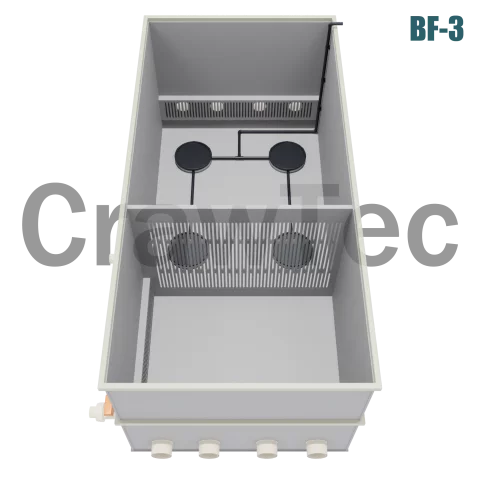
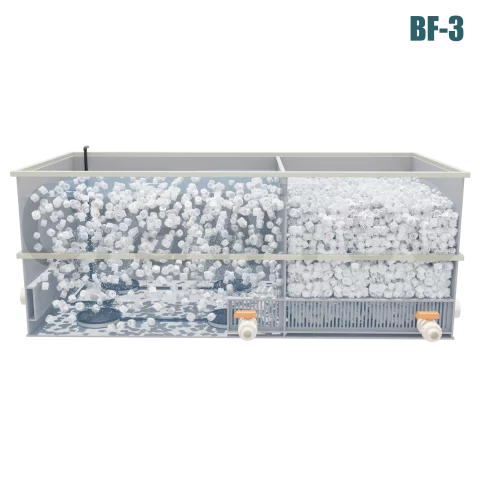
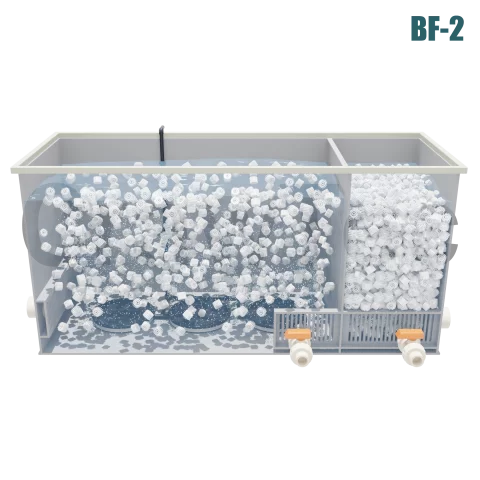
In MBBR systems, carriers move freely within a chamber, continuously self-cleaning the biofilm and providing exceptional biological capacity in compact volumes.
Different aquaculture and RAS configurations use various types of biological filters, each with specific engineering characteristics and performance advantages.
MBBR reactors (Moving Bed Biofilm Reactors). The industry standard for commercial RAS due to high efficiency, small footprint, stable performance and low maintenance. Ideal for fish farms, research hatcheries and high-density recirculation systems.
Fixed-bed biofilters. Media remains in place (static or trickling). These systems are simple and cost-effective for smaller farms, nurseries and aquaponic installations.
Trickling filters. Water trickles over static media, increasing oxygenation and enhancing biological activity. Common for hatcheries and environments requiring strong oxygen saturation.
Fluidized biofilters. Sand or granular media is suspended by upward-flow water currents. Offers high surface area but requires careful hydraulic control.
Hybrid systems. Combine MBBR + fixed-bed or trickling modules to balance stability, capacity and redundancy across different operational zones.
These systems support consistent nitrification performance, which is essential for fish health and stable production cycles.
Biofilters and MBBR reactors are used across all segments of recirculating aquaculture, from small research units to industrial fish farms.
Commercial RAS farms. Salmon, trout, tilapia, catfish, shrimp, barramundi and other species rely on large-scale MBBR modules to maintain stable biological capacity under intensive production loads.
Hatcheries and nurseries. Controlled biological filtration ensures safe water for fry and fingerlings, which are highly sensitive to ammonia and nitrite.
Aquaponics systems. Biofilters stabilize water chemistry, protecting fish while supplying nitrate-rich water for hydroponic crops.
Research and laboratory RAS units. Precision biofiltration supports experimental work, breeding programs and controlled production cycles.
Pilot and modular RAS systems. MBBR reactors allow scalable, compact designs ideal for startups, universities or mobile fish-production modules.
In all cases, stable biofiltration is the foundation of successful recirculating aquaculture.
Choosing the right biofilter or MBBR system requires a detailed understanding of hydraulic loads, fish biomass, feeding rates and system design. Key engineering factors include:
Media selection and surface area. High-quality carriers provide 500–1200 m²/m³ of protected surface area. Media durability, buoyancy and movement characteristics determine long-term performance.
Oxygen supply and aeration rate. Insufficient oxygen disrupts nitrification. Proper diffuser layout, blower sizing and air distribution are critical.
Hydraulic retention time (HRT). Adequate contact time ensures efficient ammonia and nitrite conversion. Under-sizing causes instability.
Reactor volume and load capacity. The total volume must match feeding rates and expected peak biomass loading, with margin for safety and seasonal variation.
Integration with mechanical filtration. Biofilters must receive clean, solids-free water to avoid clogging, oxygen depletion and biological stress.
Ease of maintenance. MBBR systems require minimal maintenance, while fixed-bed filters may need periodic cleaning depending on load and media type.
Material quality and longevity. Industrial-grade polyethylene, fiberglass and corrosion-resistant components extend service life in humid and saline environments.
On CEAUnion, manufacturers, engineering firms and aquaculture suppliers can list biofilters, MBBR reactors, carriers/media, hybrid systems, complete RAS filtration modules and installation services. Buyers and farm developers can compare designs, evaluate capacity ratings and contact vendors directly to select the appropriate biological filtration system for their operation.