This website uses cookies to improve functionality and analyze traffic. By continuing to browse or interact with the site, you consent to our use of cookies and acknowledge that you have read and agreed to our Privacy Policy and Terms & Conditions.

CEA project design and engineering form the technical foundation for building high-performance greenhouses, indoor farms, vertical farms and aquaculture/RAS facilities. These projects require detailed planning across architecture, climate engineering, structural design, HVAC sizing, water treatment, filtration, fertigation, lighting strategy, automation integration and energy modeling. Professional engineering ensures that CEA systems operate efficiently, achieve consistent crop performance and deliver stable ROI for growers, investors and commercial developers.
Successful CEA development integrates multiple engineering fields into a unified, fully coordinated system. Each discipline contributes to environmental control, operational efficiency and long-term facility stability.
Climate load calculations and HVAC engineering. Indoor farms and high-tech greenhouses require precise heating, cooling, dehumidification and ventilation modeling based on crop type, lighting heat load, transpiration rates and external climate conditions.
Hydraulic and water system engineering. Engineering teams design filtration loops, recirculating hydroponic systems, fertigation networks, aquaculture water flows, pump sizing, drain systems and water treatment modules including RO, UV and ozone systems.
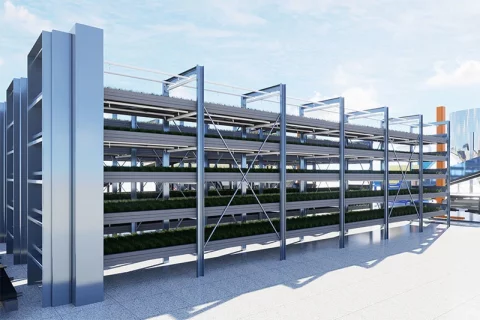
Structural and architectural design. Greenhouse frames, steel structures, multi-span buildings, grow rooms and vertical farm rack systems must meet snow, wind and seismic standards while accommodating climate and lighting infrastructure.
Electrical and lighting engineering. Designs include LED layouts, DLI/PPFD distribution mapping, electrical load balancing, cable management and integration with automation systems and dimming controls.
Automation and control system integration. Engineering teams integrate climate controllers, SCADA/PLC platforms, IoT sensors, fertigation controllers and energy-management systems into a unified operational network.
Energy modeling and efficiency optimization. Engineers evaluate heating/cooling loads, lighting energy use, heat-recovery options and ventilation strategies to optimize operating costs in commercial environments.
Aquaculture and RAS engineering. For aquaponics or fish-based systems, design includes tank layout, biofiltration capacity, oxygenation systems, waste removal loops, hydraulic balancing and biosecurity protocols.
Together, these engineering disciplines create the technical backbone required for efficient, resilient and scalable CEA operations.
Engineering quality is one of the most important factors determining the long-term success of a controlled-environment project. Proper design reduces risks, stabilizes production and maximizes profitability.
Commercial greenhouse development. Engineering ensures optimal structure type, glazing material, ventilation, heating and fertigation systems tailored to local climate and crop requirements.
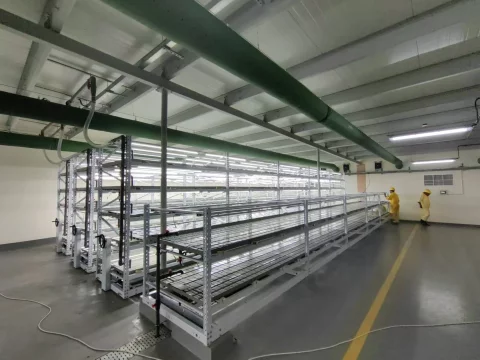
Vertical farming and indoor cultivation facilities. Tight environmental control requires precise HVAC sizing, airflow planning, dehumidification strategy, LED heat-load modeling and rack-layout coordination.
Aquaponics and RAS facilities. Hydraulics, biofiltration sizing and system redundancy must be engineered to maintain water quality and safeguard livestock health.
Seedling production and nurseries. Designs include gentle climate zones, propagation lighting, humidity control and air distribution optimized for young plants.
Research facilities and controlled chambers. Engineering ensures repeatability, extreme climate stability and precise environmental control for scientific work.
Retrofitting and upgrading existing buildings. Engineering teams redesign airflow, install new lighting schemes, upgrade HVAC and integrate automation to modernize older facilities.
Well-engineered CEA projects achieve high reliability, predictable crop cycles and optimized operational costs across all production models.
Choosing the right engineering provider is essential for a successful project. Important considerations include:
Proven experience in CEA. Vendors with greenhouse, indoor farm or RAS portfolios understand real-world constraints and optimize systems accordingly.
Multidisciplinary capabilities. The best partners offer climate, structural, hydraulic, electrical and automation engineering under one roof, ensuring full system coordination.
Crop-specific knowledge. Engineering teams familiar with leafy greens, vine crops, berries, microgreens, cannabis, ornamentals or aquaculture can design systems tailored to biological requirements.
Local compliance and permitting understanding. Building codes, environmental regulations, electrical standards and water rules vary by region and must be incorporated into design.
Advanced modeling tools. CFD airflow modeling, lighting simulations (PPFD/DLI mapping), energy modeling and hydraulic analysis improve design accuracy and reduce operational issues.
Commissioning, documentation and support. Reliable engineering partners provide manuals, schematics, training, commissioning and ongoing support before and after project launch.
On CEAUnion, engineering firms, consultants and integrators can list project design services, feasibility studies, full engineering packages, 3D modeling, facility optimization programs and turnkey CEA design solutions. Developers and growers can evaluate providers, compare capabilities and contact experts to plan, design or scale their controlled-environment projects.