Best-practice LED light recipes, PPFD levels and spectrum optimization for commercial microgreen production
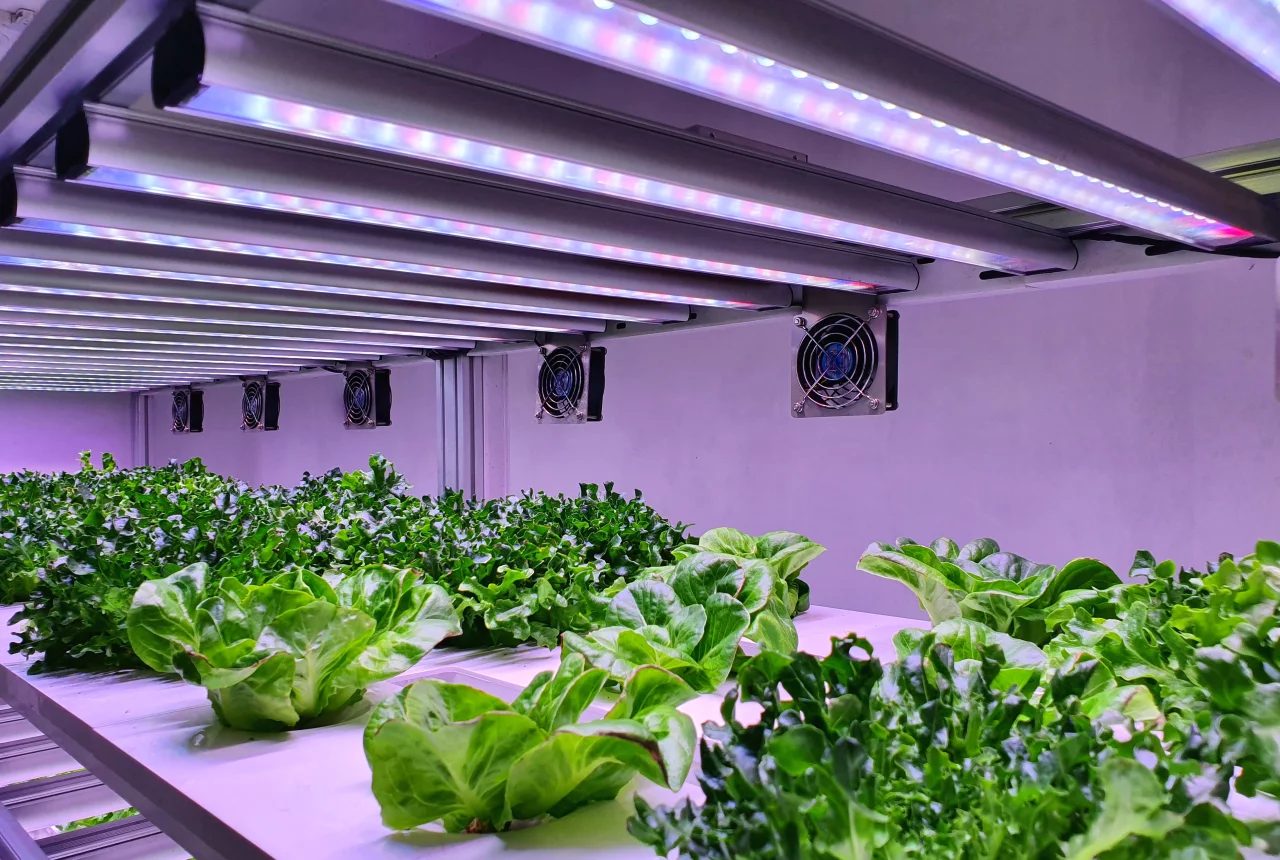
Microgreens respond strongly to precise PPFD and spectral tuning, making LED lighting a critical control point for consistent biomass, coloration and nutritional density. Unlike mature crops, microgreens reach commercial maturity in 7–14 days, so the lighting strategy must deliver rapid growth without excessive energy consumption. This article provides a technical analysis of PPFD requirements, spectral distribution and photoperiod optimization for commercial microgreen production in controlled environments.
Understanding Microgreen Light Requirements
Microgreens have shallow canopies, extremely high planting density and short production cycles. Their physiology is sensitive to both light intensity and wavelength distribution. Because their leaves remain small and thin, microgreens convert light energy efficiently, allowing growers to use moderate PPFD values with excellent results while avoiding unnecessary energy input.
Recommended PPFD Levels for Microgreens
The optimal PPFD range depends on species, but most commercial microgreens thrive under moderate intensities. Higher intensities do not necessarily translate into higher yields because the crop’s growth window is too short to benefit from excessive light saturation.
Typical PPFD recommendations include:
- 120–180 µmol/m²/s for general microgreen production
- 150–220 µmol/m²/s for coloration-driven varieties like amaranth or red cabbage
- 100–150 µmol/m²/s for delicate species such as basil microgreens
- Reduced intensities (80–120 µmol/m²/s) for shade-tolerant varieties or germination phases
Maintaining stable PPFD uniformity across trays is essential. Uneven distribution leads to variations in stem elongation, coloration and dry matter content, reducing the overall commercial grade of the harvest.
Spectral Composition for Microgreens
The spectrum used for microgreens influences not only growth rate but also morphology, coloration, secondary metabolites and chlorophyll development. Since microgreens require rapid canopy expansion and attractive pigment expression, their spectral needs differ slightly from standard leafy greens.
Effective spectral zones typically include:
- Blue light (430–470 nm): Regulates compactness, reduces stretching and enhances anthocyanins.
- Red light (630–670 nm): Drives photosynthesis and biomass accumulation.
- Far-red light (720–750 nm): Useful in small quantities to influence stem elongation and shade responses.
- Green light (510–550 nm): Improves canopy penetration and visual quality.
- Full-spectrum white: Used to balance color rendering and improve visual inspection during production.
For most microgreens, the ideal spectrum is a cool, blue-leaning white supplemented with balanced red output. This combination achieves compact growth, intense coloration and high nutritional density. Heavy far-red or warm-white recipes tend to produce elongated stems, which may reduce market value.
Photoperiod Strategies
The short lifecycle of microgreens allows flexible photoperiod management. Extended light hours accelerate growth but can also lead to energy inefficiencies if used excessively. Choosing the correct duration requires balancing operational cost with crop performance.
Common photoperiod configurations include:
- 14–16 hours per day for balanced growth and energy efficiency
- 16–18 hours for species requiring rapid early biomass formation
- 12–14 hours when intensities are higher or when controlling excessive elongation
Most growers avoid continuous 24-hour lighting because microgreens still benefit from a dark period for metabolic recovery and carbohydrate balancing.
Light Recipes for Specific Microgreen Categories
Different microgreen families respond uniquely to spectrum and PPFD combinations. Engineering the correct recipe improves crop consistency and uniformity across successive batches.
Typical recipes by crop type include:
- Red and purple microgreens (amaranth, radish, red cabbage): 150–220 PPFD with elevated blue percentage (20–25%) to intensify pigmentation.
- Brassicas (broccoli, kale, mustard): 140–180 PPFD with balanced red/blue spectrum for compact leaves.
- Herb microgreens (basil, cilantro, dill): 100–150 PPFD, slightly warmer spectrum to promote leaf expansion.
- Pea shoots: 150–180 PPFD with moderate far-red to encourage controlled elongation.
Heat Management and Distance Between LEDs and Canopy
Because microgreens are grown at very high density, heat buildup on the leaf surface can cause desiccation, tip burn and irregular growth. Even though LEDs produce less radiant heat than HPS systems, dense multilayer racks require careful thermal modeling.
Key distance considerations include:
- Maintain 20–35 cm between LEDs and canopy depending on fixture optics
- Ensure airflow is adequate to remove boundary-layer heat
- Use lenses or diffusers to maintain uniform PPFD on shallow trays
- Avoid excessive radiant flux on sensitive varieties like basil
Energy Efficiency Considerations
Microgreens offer excellent opportunities for lighting energy optimization because of their short cycles and low canopy height. The economic performance of microgreen operations depends strongly on lighting efficiency measured as grams produced per kWh.
Efficiency improvements may include:
- Using mid-power white LEDs with high efficacy (>2.7 µmol/J)
- Reducing PPFD during germination and early emergence
- Integrating dimming schedules to match plant development
- Selecting optics that reduce light spill and wasted coverage
Quality Indicators Linked to Light Conditions
Visual and nutritional quality indicators—including coloration, cotyledon expansion and antioxidant levels—are tightly linked to how microgreens interact with the lighting environment. Monitoring these factors helps fine-tune the lighting recipe for each batch.
Important quality markers include:
- Uniform pigmentation and color saturation
- Compact stem structure without excessive elongation
- Consistent cotyledon size and symmetry
- High antioxidant and vitamin density
Conclusion
Optimizing LED light recipes for microgreens requires careful coordination of PPFD, spectral composition and photoperiod. Moderate intensities, blue-leaning spectra and controlled heat loads support uniform biomass accumulation and strong coloration without unnecessary energy costs. By applying a structured, engineering-driven approach to light management, growers can enhance quality, predictability and overall efficiency in commercial microgreen production.