Aquaponics as an integrated production system: engineering differences, biological constraints and operational trade-offs compared to hydroponics
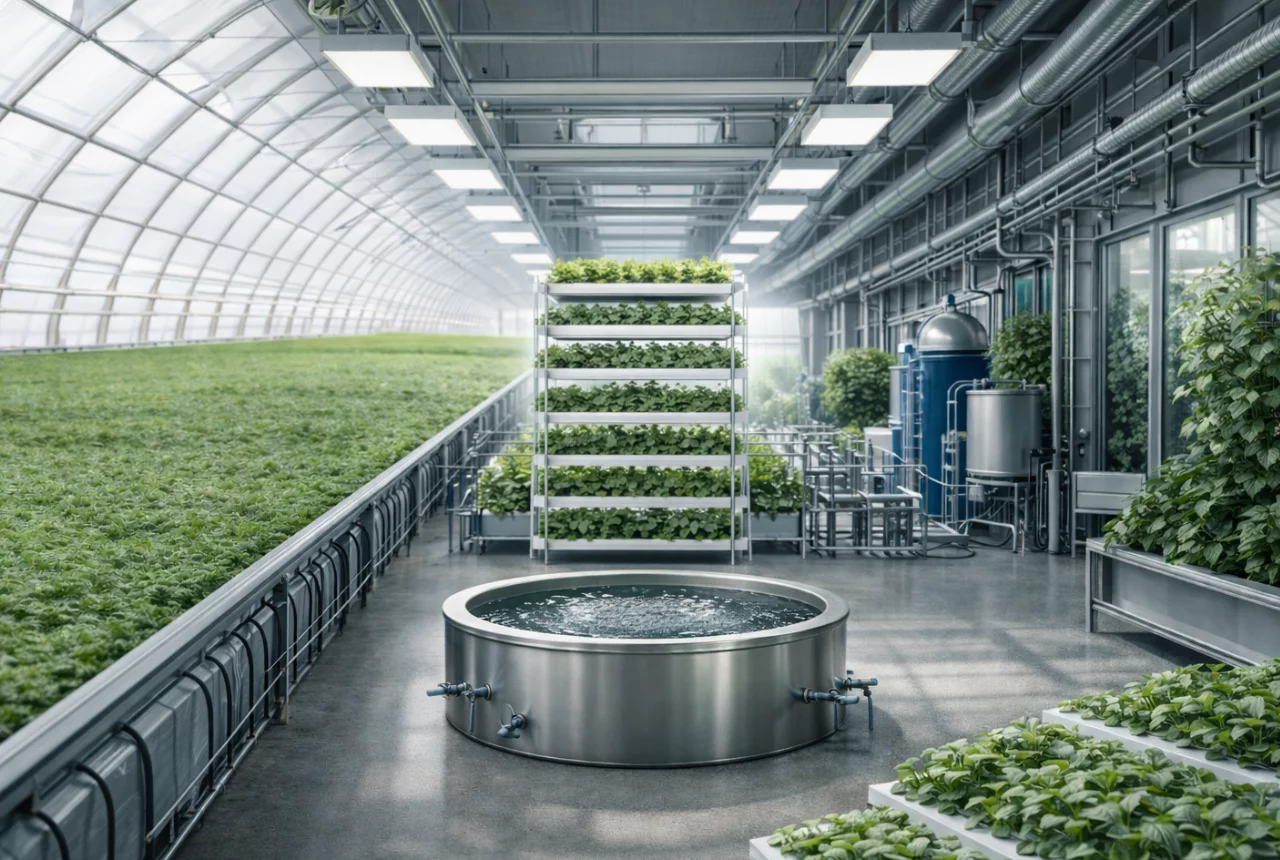
Aquaponics is often described as a combination of aquaculture and hydroponics. In commercial controlled environment agriculture (CEA), however, aquaponics must be understood as a fundamentally different production model with its own engineering logic, biological constraints and operational trade-offs.
This article provides a technical, system-level overview of aquaponics for professional operators and engineers, with a clear focus on how and why aquaponic systems differ from conventional hydroponics in design, nutrient management, water quality control and automation complexity.
What aquaponics actually is in commercial CEA systems
In its simplest form, aquaponics integrates fish production with plant cultivation by using fish waste as a nutrient source for crops. Unlike hydroponics, where nutrient composition is precisely formulated, aquaponics relies on biological processes to generate plant-available nutrients.
From an engineering perspective, aquaponics is best described as a biologically coupled, multi-trophic production system. Fish, bacteria and plants form an interdependent loop where changes in one subsystem directly affect the performance and stability of the others.
Why aquaponics cannot be treated as modified hydroponics
A common misconception is that aquaponics is simply hydroponics with fish added. This assumption leads to many design and operational failures.
In hydroponics:
- Nutrient composition is fully controlled
- EC and pH targets are optimized for plant uptake
- Water chemistry can be rapidly adjusted
In aquaponics:
- Nutrients are generated biologically
- pH must balance fish health, bacteria activity and plant uptake
- Rapid chemical corrections are limited or risky
This fundamental difference makes aquaponics more complex, less flexible and slower to respond to corrective actions than hydroponics.
Biological coupling as the core difference
The defining characteristic of aquaponics is biological coupling. Plant nutrition depends on fish metabolism and microbial nitrification, rather than direct nutrient dosing.
Fish metabolism and nutrient generation
Fish excrete nitrogen primarily as ammonia (NH₃/NH₄⁺). This waste stream becomes the primary nitrogen source for plants. However, fish feed formulations are designed for animal growth, not for optimal plant nutrition.
As a result, nutrient ratios in aquaponics rarely match plant demand, especially for potassium, calcium, iron and micronutrients.
Nitrification as a production bottleneck
Ammonia must be converted into nitrate through nitrification before plants can utilize it efficiently. This biological process is temperature- and oxygen-dependent and introduces a critical rate-limiting step in aquaponic systems.
Any disruption to nitrification directly affects both fish health and plant performance.
Nutrient availability and limitations in aquaponics
Unlike hydroponics, aquaponics operates with inherent nutrient constraints. Even when total nitrogen levels appear sufficient, other essential elements may remain limiting.
Macronutrient imbalances compared to hydroponics
| Nutrient | Hydroponics | Aquaponics |
|---|---|---|
| Nitrogen | Fully adjustable | Biologically limited |
| Potassium | Precisely dosed | Often deficient |
| Calcium | Controlled via formulation | Indirectly influenced by water chemistry |
Supplementation is possible, but must be carefully balanced to avoid adverse effects on fish and biofilter bacteria.
Micronutrient supplementation challenges
Iron deficiency is one of the most common problems in aquaponics. Chelated iron is frequently added, but dosing frequency and form must consider system pH and microbial activity.
Over-supplementation risks toxicity to fish, while under-supplementation limits plant growth.
System architectures in commercial aquaponics
Commercial aquaponics systems are typically classified as coupled or decoupled. Each architecture reflects a different approach to managing biological constraints.
Coupled aquaponic systems
In coupled systems, fish and plants share a single recirculating water loop. This simplicity reduces capital cost but tightly links system stability.
- Single water chemistry regime
- Limited optimization flexibility
- Higher biological risk
Decoupled aquaponic systems
Decoupled systems separate fish and plant loops, allowing partial optimization of nutrient and pH conditions.
This approach improves plant productivity but increases system complexity, capital cost and operational requirements.
Water quality management and competing requirements
Water quality targets in aquaponics must simultaneously satisfy fish, nitrifying bacteria and plants. These requirements are often conflicting.
Fish health vs plant nutrient uptake
Fish generally prefer neutral to slightly alkaline pH, while many crops perform best under mildly acidic conditions.
Aquaponic systems therefore operate in a compromise range, typically between pH 6.8 and 7.2, which is suboptimal for many plant species.
Temperature, pH and dissolved oxygen trade-offs
Temperature affects:
- Fish metabolism
- Bacterial nitrification rates
- Oxygen solubility
Managing these trade-offs requires careful system design and conservative operational strategies.
Filtration, solids management and biofilter design
Solids management is more critical in aquaponics than in hydroponics. Uneaten feed and fecal matter rapidly degrade water quality.
Mechanical solids removal
Drum filters, radial flow settlers or screens are commonly used to remove suspended solids before biofiltration.
Biological filtration and TAN control
Biofilters must be sized for peak ammonia loads, not average conditions. Undersized biofilters are a leading cause of system instability.
Automation and control complexity in aquaponics
Automation in aquaponics must prioritize system stability over optimization. Unlike hydroponics, aggressive control actions can destabilize biological processes.
Sensor priorities and control loops
Critical parameters include:
- Dissolved oxygen
- Temperature
- Ammonia and nitrite levels
- pH trends
Alarm thresholds should be conservative, with emphasis on early detection rather than rapid correction.
Failure modes and risk management
Power loss, pump failure or aeration interruption can lead to fish mortality within hours. Redundancy and emergency response planning are essential.
Productivity, yield stability and economic realities
While aquaponics offers sustainability benefits, its commercial productivity often lags behind optimized hydroponics.
Lower yields, higher labor intensity and increased system complexity must be carefully weighed against market positioning and risk tolerance.
Common misconceptions about aquaponics efficiency
- That aquaponics eliminates fertilizer inputs
- That it is simpler than hydroponics
- That biological balance is self-regulating
In practice, aquaponics requires more expertise, not less.
When aquaponics is and is not the right production model
Aquaponics can be suitable for:
- Niche markets valuing integrated fish and plant production
- Educational or demonstration facilities
- Regions with limited access to fertilizers
It may be less suitable for large-scale, yield-optimized plant production where predictability and control are paramount.
Key engineering takeaways for CEA operators
Aquaponics is not a simplified alternative to hydroponics. It is a biologically constrained, tightly coupled system that demands conservative design, robust filtration and disciplined operation.
For operators willing to manage its complexity, aquaponics offers a unique production model. For others, conventional hydroponics may provide greater efficiency and stability.