
Recirculating aquaculture systems (RAS): stocking density, mass balances, biofiltration sizing and water-quality stability across species and production stages
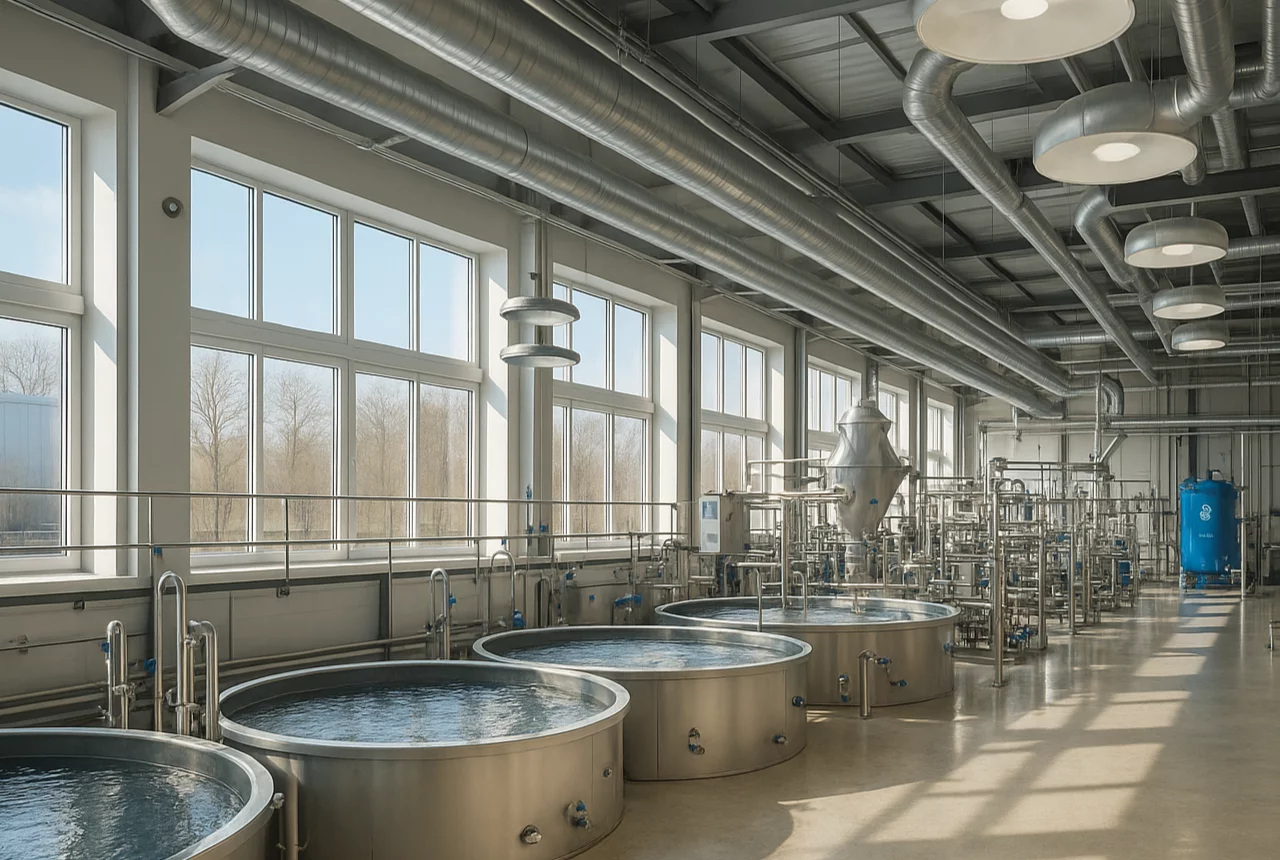
Recirculating aquaculture systems (RAS) are often presented as a technological solution to reduce water use and increase production intensity in aquaculture. In practice, RAS represent a fundamental shift in how aquatic biomass is produced, controlled and scaled.
Rather than relying on continuous dilution through water exchange, RAS concentrate biological processes within a closed or semi-closed loop. This transforms aquaculture from a water-driven activity into a system governed by mass balances, biological reaction rates, hydraulic transport and risk management.
This article explains RAS as an integrated production system. It starts with a clear explanation of what RAS are and why they exist, then progressively moves into the engineering and biological constraints that define system performance. Special emphasis is placed on stocking density, as it remains the most misunderstood and misused parameter in RAS design.
What recirculating aquaculture systems (RAS) are and why they exist
A recirculating aquaculture system is a production system in which water is continuously treated and reused to maintain suitable conditions for aquatic organisms. Typically, 90–99% of system water remains within the loop, while only a small fraction is replaced daily.
Water quality in RAS is maintained through a combination of mechanical solids removal, biological filtration, oxygenation, carbon dioxide removal and controlled hydraulics. Unlike ponds or flow-through systems, RAS must actively manage every major waste stream generated by the cultured biomass.
RAS exist because they allow aquaculture to operate under constraints where traditional systems fail: limited water availability, strict discharge regulations, biosecurity requirements and the need for predictable production.
RAS compared to flow-through and pond systems
In flow-through systems, water quality is preserved by dilution. Fresh water continuously enters the system and carries waste away. System stability depends primarily on water availability and intake quality.
In RAS, dilution is minimal. Waste products accumulate unless they are removed or transformed. This means that biological processes that are negligible in flow-through systems become central design elements in RAS. The system must be engineered to process waste at the same rate it is generated.
As a result, RAS behave more like industrial process systems than traditional farms. Errors do not dissipate downstream; they remain inside the loop.
RAS as controlled biological systems
Despite their reliance on pumps, filters and sensors, RAS are not purely mechanical systems. Their performance is ultimately constrained by biology: fish metabolism, microbial nitrification and gas exchange.
Engineering can expand the operating envelope, but it cannot override biological limits. Successful RAS design therefore requires understanding where engineering ends and biology begins.
Aquatic species commonly produced in RAS today
RAS can support a wide range of aquatic species, but not all species are equally suited to recirculating conditions. Species biology strongly influences acceptable stocking density, feeding intensity and system resilience.
Finfish species
Common finfish species cultured in RAS include Atlantic salmon, trout, tilapia, catfish and barramundi. Each species differs in oxygen demand, waste production and sensitivity to water quality fluctuations.
Salmonids, for example, require high dissolved oxygen levels and exhibit stress responses at relatively low TAN concentrations. Tilapia are more tolerant of suboptimal water quality but generate significant organic and nitrogenous waste at high feeding rates.
These differences mean that a RAS designed for one species cannot be directly transferred to another without substantial modification.
Crustaceans: shrimp and crayfish
Shrimp and crayfish are increasingly produced in RAS, often at high densities. However, crustaceans introduce additional complexity related to molting cycles, behavior and sensitivity to oxygen depletion.
High-density shrimp systems can tolerate elevated nitrate levels but are extremely sensitive to dissolved oxygen drops and fine solids accumulation. As a result, RAS for crustaceans often prioritize aeration redundancy and aggressive solids management.
Species biology as a design constraint
Species selection determines not only water quality targets but also system risk tolerance. Fast-growing species with high feed intake rates place greater stress on biofilters and oxygenation systems.
For this reason, species biology must be treated as a primary design input, not a secondary operational consideration.
Why stocking density is the primary design driver
Stocking density is often discussed as a productivity metric, but in RAS it functions as a system stress multiplier. As density increases, all biological and engineering processes accelerate simultaneously.
Higher density increases feed input, which increases waste generation, oxygen demand and system instability. At the same time, recovery margins shrink and failure consequences escalate.
Understanding density metrics
Stocking density is commonly expressed as kilograms of biomass per cubic meter. While useful, this metric hides critical information about feed rate, fish size and metabolic activity.
A more informative approach considers biomass relative to system flow and daily feed input. Two systems with identical biomass density can behave very differently depending on feeding intensity.
Life stage and density tolerance
Juvenile fish generally tolerate higher densities due to lower absolute feed intake and waste production. As fish grow, metabolic load increases nonlinearly, reducing acceptable density even if biomass remains constant.
Ignoring life-stage effects often leads to systems that appear stable during early production phases but fail during later grow-out stages.
Density as a risk multiplier
At low densities, RAS can absorb operational mistakes. At high densities, the same mistakes propagate rapidly and system recovery becomes uncertain.
For this reason, stocking density should be defined based on acceptable risk, not theoretical maximums.
Feed-based mass balance as the real sizing foundation
In RAS, feed input is the primary driver of system loading. Nearly every critical design parameter scales with feed rate rather than standing biomass.
From feed to TAN generation
Protein intake through feed results in ammonia excretion via gills and urine. The fraction of protein converted to TAN varies by species, feed composition and feeding strategy.
This variability introduces uncertainty into design calculations. Engineering safety margins are therefore essential, particularly at high feeding rates.
From feed to oxygen demand
Oxygen demand in RAS arises from three sources: fish respiration, nitrification and oxidation of organic matter. As feed input increases, nitrification oxygen demand can rival or exceed fish respiration demand.
Designs that account only for fish oxygen consumption frequently underestimate total system demand.
CO₂ production and accumulation
Carbon dioxide is produced alongside oxygen consumption. While oxygen can be supplemented, CO₂ must be physically removed from the system.
At high densities, CO₂ accumulation often becomes the first limiting factor, suppressing appetite and growth even when oxygen appears sufficient.
Hydraulics and turnover rate as biological control parameters
In RAS, hydraulics are not merely a matter of moving water from one component to another. Flow rate, mixing efficiency and residence time directly influence how waste products are transported, how uniformly oxygen is distributed and how effectively biofilters can operate.
Poor hydraulic design often becomes visible only at higher stocking densities, when biological loading exceeds the system’s ability to redistribute and process waste evenly.
Tank turnover versus system hydraulic residence time
Tank turnover rate is commonly used as a design indicator, describing how often the tank volume is exchanged per hour. However, high turnover alone does not guarantee effective waste removal or mixing.
System hydraulic residence time (HRT) describes how long water remains within specific treatment components, such as biofilters or degassing units. A mismatch between tank turnover and HRT can lead to situations where water circulates rapidly but spends insufficient time in treatment stages.
Mixing efficiency, dead zones and solids transport
Inadequate mixing creates localized zones with reduced oxygen concentration and elevated waste levels. These dead zones become increasingly problematic as stocking density increases.
Solids that are not properly transported to mechanical filtration units break down within the system, increasing biological oxygen demand and stressing biofilters. Effective hydraulic design therefore supports both fish welfare and downstream treatment performance.
Solids management and organic load control
Solids management is one of the most underestimated aspects of RAS performance. Uneaten feed, fecal matter and biofilm fragments contribute significantly to organic loading.
If not removed efficiently, solids degrade water quality indirectly by increasing oxygen demand and promoting heterotrophic bacterial growth.
Why suspended solids drive system instability
Suspended solids increase turbidity and serve as a substrate for microbial activity. As solids accumulate, heterotrophic bacteria consume oxygen that would otherwise be available for fish and nitrifying bacteria.
This competition intensifies at higher feed inputs, making solids management a limiting factor long before biofilter capacity is reached.
Mechanical filtration strategies
Common solids removal technologies include drum filters, radial flow settlers and foam fractionation. Each targets a different particle size range and imposes different hydraulic constraints.
Selection should be based on expected solids load, particle characteristics and the desired balance between removal efficiency and maintenance complexity.
Fine solids and biofilter stress
Fine particles that bypass mechanical filtration accumulate within biofilters, where they promote heterotrophic growth. This reduces effective nitrification capacity by occupying surface area and consuming oxygen.
In high-density RAS, fine solids control often determines long-term system stability.
Biofiltration sizing logic and biological constraints
Biofiltration is the biological heart of RAS. Its role is to convert toxic ammonia into less harmful nitrate through nitrification.
However, biofilter performance is highly sensitive to temperature, oxygen availability and loading fluctuations.
TAN loading and temperature effects
Nitrification rates increase with temperature, but only within biological limits. Published conversion rates vary widely and often assume ideal conditions.
In practice, conservative sizing and temperature correction factors are essential, especially in systems with variable feed input or seasonal temperature shifts.
Biofilter technologies and trade-offs
Moving bed biofilm reactors (MBBR), fixed-bed filters and fluidized sand filters each offer different advantages.
MBBR systems provide robustness and flexibility, while fixed-bed systems offer compactness at the cost of sensitivity to clogging. Fluidized systems can achieve high rates but require precise hydraulic control.
Start-up dynamics and shock loading
Biofilters require time to mature. During start-up, nitrifying populations are vulnerable to sudden increases in TAN load.
Rapid biomass or feeding increases can overwhelm immature biofilters, leading to prolonged instability even if nominal capacity appears sufficient.
Water quality targets under increasing stocking density
Water quality targets in RAS are not fixed values. They shift as stocking density and feeding intensity increase.
Dissolved oxygen as a limiting factor
Dissolved oxygen requirements increase with both biomass and feed input. At high densities, maintaining adequate oxygen levels becomes a continuous challenge.
Small drops in oxygen concentration can trigger stress responses, reducing feed intake and increasing susceptibility to disease.
TAN, nitrite and nitrate dynamics
TAN and nitrite represent acute stressors with immediate physiological effects. Nitrate, while less toxic, accumulates steadily and reflects long-term system balance.
As density increases, acceptable concentrations decrease, as fish become less tolerant to cumulative stress.
pH and temperature compromises
Optimal pH and temperature for fish rarely coincide with those for nitrifying bacteria. RAS therefore operate in compromise zones that favor system stability over peak performance.
At higher densities, these compromises become more pronounced, requiring larger biofilters or reduced feeding rates.
Oxygenation and degassing beyond basic aeration
Aeration alone is insufficient in intensive RAS. Oxygenation and degassing must be treated as system-level processes.
Oxygen transfer capacity and peak demand
Oxygen systems must be sized for peak daily demand, not average consumption. Handling, grading or temperature fluctuations can temporarily double oxygen requirements.
Without sufficient reserve capacity, such events can destabilize the entire system.
CO₂ stripping and accumulation
Carbon dioxide removal relies on gas exchange rather than supplementation. Degassing efficiency decreases as biomass and feed input increase.
Chronic CO₂ accumulation often limits growth before other parameters appear critical, making it a hidden constraint in high-density RAS.
Failure scenarios and response windows
At high stocking densities, system failures escalate rapidly. Power loss or oxygen supply interruption can lead to lethal conditions within hours.
Redundant systems and emergency protocols extend response windows but cannot eliminate risk entirely.
Automation, sensors and operational reality
Automation in RAS supports monitoring and response, but it does not replace biological understanding.
Sensor priorities and limitations
Continuous monitoring of dissolved oxygen, temperature and pH is essential. Other parameters, such as TAN and nitrite, are more reliably tracked as trends.
Sensor drift, fouling and calibration errors introduce uncertainty, which must be accounted for in control strategies.
Alarm philosophy and human factors
Effective alarm systems prioritize early warning and clarity. Excessive alarms reduce responsiveness and increase operational risk.
Alarm thresholds should reflect system vulnerability, particularly under high-density conditions.
Practical stocking density ranges and interpretation
Published stocking density values vary widely because they reflect different assumptions, species, system designs and management skill levels.
Rather than absolute limits, density should be interpreted as an operating envelope that narrows as feed input and biological loading increase.
Beyond a certain point, increasing density yields diminishing returns and disproportionate increases in risk.
Key takeaways for RAS operators and engineers
Recirculating aquaculture systems are integrated biological and engineering systems where stocking density, feed input and system design are inseparable.
Successful RAS operation depends on conservative assumptions, robust safety margins and continuous learning. Many high-density performance limits remain context-dependent and require experience beyond theoretical design values.